
12.07.2026
Results of the Study on the Effectiveness of Initiative Budget Projects
The Chamber of Accounts analyzed the effectiveness of the initiative budgeting processes conducted during the 1st and 2nd seasons of 2025 and the 1st season of 2026, as well as the efficiency of the use of funds allocated for these projects, during May–June of the current year. In addition, a field study was carried out using Surkhandarya Region as a case study.
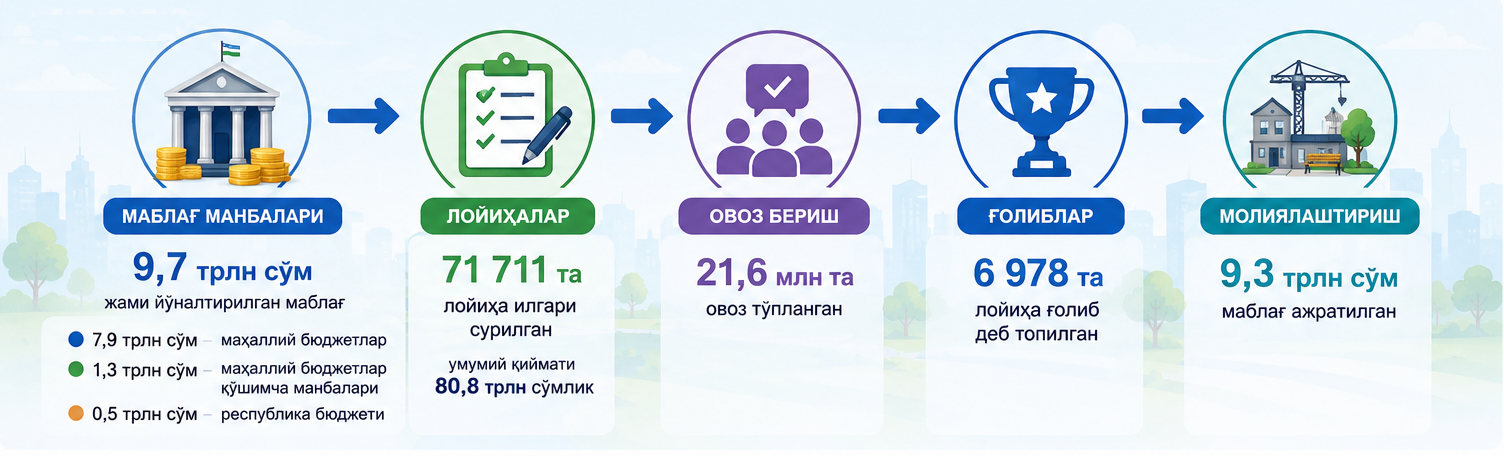
The analysis revealed that a total of UZS 9.7 trillion was allocated to the Citizens' Initiative Fund. Of this amount, UZS 7.9 trillion was formed from local budget funds, UZS 1.3 trillion from additional sources of local budgets, and UZS 0.5 trillion from the State Budget.
A total of 71,711 projects with an overall value of UZS 80.8 trillion were proposed by initiative groups. Of these, 6,978 projects received a total of 21.6 million votes, were declared winners, and were allocated UZS 9.3 trillion in funding.
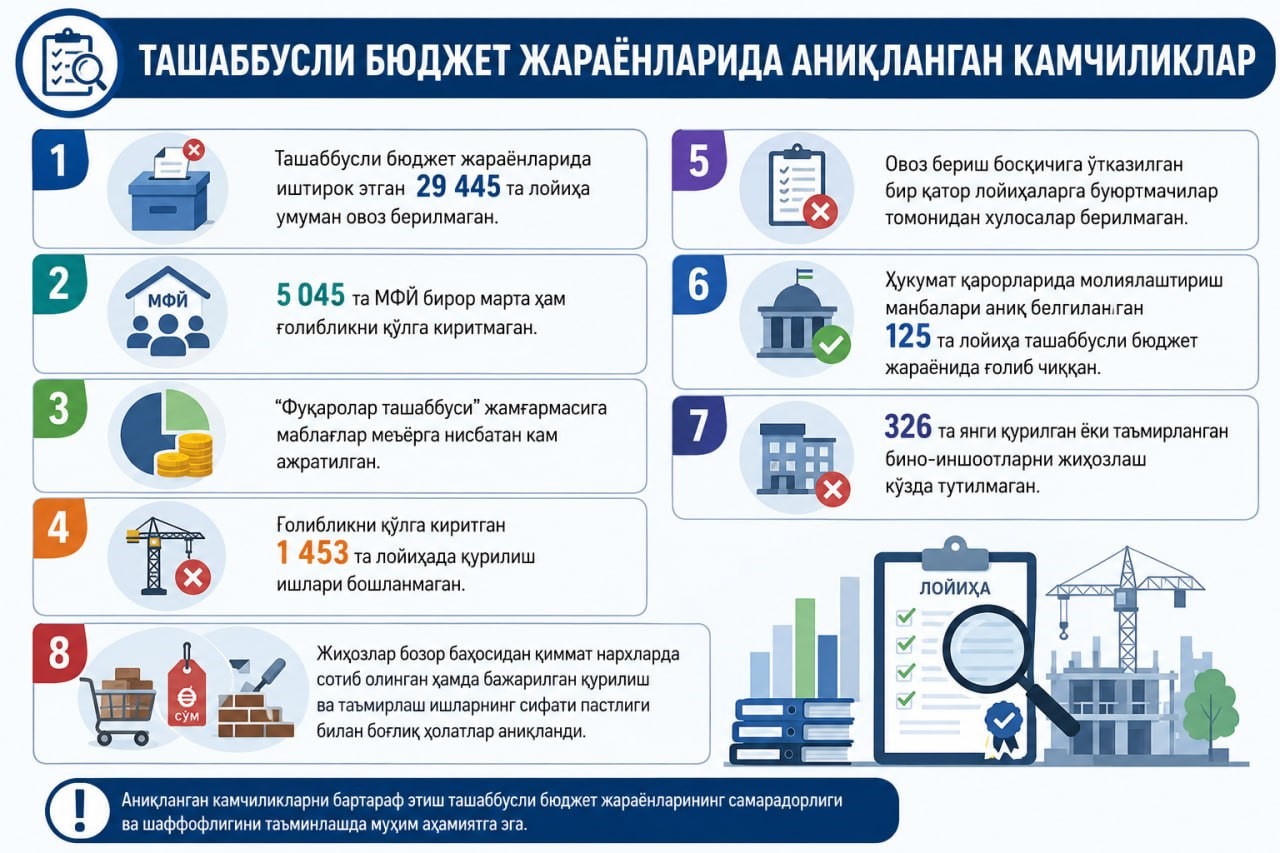
During the study, the working group identified a number of systemic issues in the organization of the initiative budgeting process. In particular:
no votes were cast for 29,445 projects that participated in the initiative budgeting process, while 5,045 mahalla citizens' assemblies (MCAs) have never had a winning project;
local authorities allocated funds to the Citizens' Initiative Fund below the established in legislative;
construction work had not commenced for 1,453 winning projects;
for a number of projects admitted to the voting stage, the contracting entities failed to provide the required technical conclusions;
125 projects whose funding sources had already been explicitly determined by Government resolutions nevertheless became winners of the initiative budgeting process;
no provision was made for equipping 326 newly constructed or renovated buildings and facilities;
during the study in Surkhandarya Region, cases were identified where equipment had been purchased at prices exceeding market value, as well as instances of poor-quality construction and renovation works.
Based on the findings, a nine-point Action Plan was developed to improve the initiative budgeting process, eliminate the identified shortcomings, and prevent their recurrence.
The key measures include:
full digitalization of the initiative budgeting process;
the use of artificial intelligence during the project screening and selection stage;
strengthening quality control mechanisms for completed works;
establishing a registry of organizations' equipment needs;
introducing a mandatory requirement to equip newly constructed buildings and facilities using the relevant budget allocations.
The implementation of these measures will enhance transparency in the initiative budgeting process, ensure the implementation of projects that are most important for the population, and promote the efficient use of public funds.
Following the study, the Chamber of Accounts submitted relevant recommendations to the Ministry of Economy and Finance and the Khokimiyat of Surkhandarya Region to improve the initiative budgeting process, discuss the study findings, and determine the necessary follow-up measures.
![[object Object]](https://back.ach.gov.uz/media/view/file_3d83e197ae37fa039e0d32ac.jpg)
![[object Object]](https://back.ach.gov.uz/media/view/file_a3b1c8bb554833cf86d75afc.jpg)
![[object Object]](https://back.ach.gov.uz/media/view/file_136b917c43f48488726efcc4.jpg)
![[object Object]](https://back.ach.gov.uz/media/view/7d1ec744-a4f3-2974-90f1-a482cd8e663b.jpg)
![[object Object]](https://back.ach.gov.uz/media/view/file_48566d33c405db9a740c1a5d.jpg)