
27.04.2026
In the first quarter of the current year, the Accounts Chamber conducted a comprehensive assessment of the measures being implemented for the socio-economic development of the Namangan region.
The study showed that although positive growth rates were observed in the region’s socio-economic development indicators, there are still problems and untapped reserves in achieving certain targets across various sectors and industries.
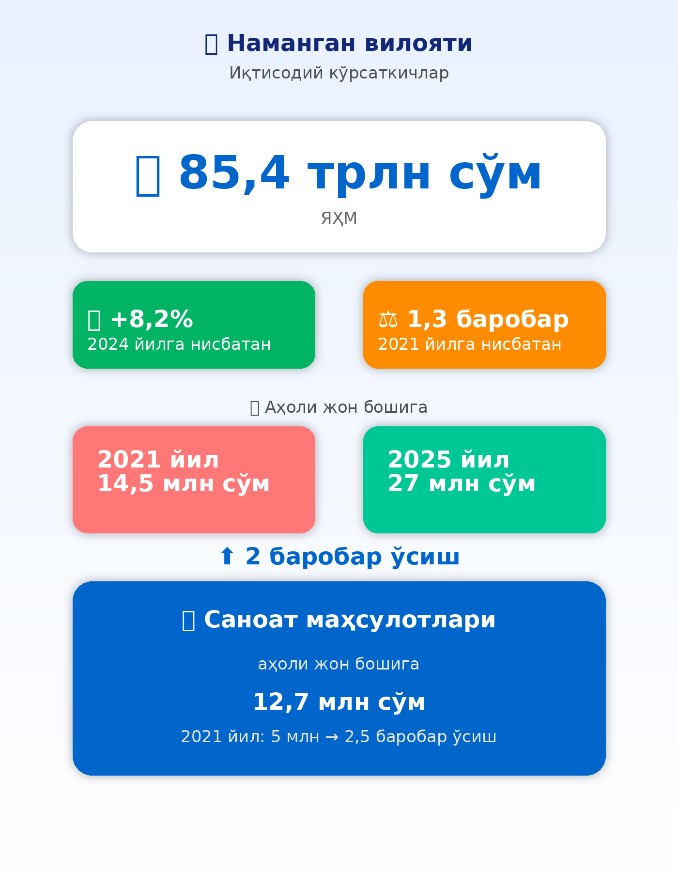
In 2025, the Gross Regional Product (85.4 trillion soums) increased by 8.2 percent compared to 2024 and by 1.3 times compared to 2021. On a per capita basis, it amounted to 27 million soums, which is almost twice as much as five years ago (14.5 million soums in 2021).
The volume of industrial output per capita in the region averaged 12.7 million soums, increasing by 2.5 times compared to 2021 (5 million soums).
At the same time, this indicator was higher in Turaqurgan district (26.2 million soums) and Namangan city (16.6 million soums), while it remained low in Yangiqurgan (2.3 million soums), Norin (3.8 million soums), Pop (4.1 million soums), and Chortoq (4.8 million soums) districts.
In agriculture, production volumes in Chortoq (7.3%), Mingbuloq (7.1%), Pop (6.1%), and Namangan (5.8%) districts exceeded the regional average, whereas in Kosonsoy (1.4%) and Uychi (2.9%) districts they were below the regional average.
Additionally, export volumes decreased compared to previous years in Namangan city, Davlatabad district, and Pop district.
In 2023–2025, within the framework of the investment program, 3,540 regional and 464 foreign investment projects were implemented; however, in some enterprises, tax reports did not reflect growth in the volume of goods (works, services).
The analysis paid particular attention to increasing preschool education coverage, creating appropriate conditions, and carrying out construction and repair works in medical institutions in need of renovation.
From additional sources, it was planned to allocate 5.6 billion soums for construction and repair works in 7 educational and medical institutions.
Furthermore, in 2023–2025, due to the reduction of the shadow economy and the expansion of the powers of local Councils of People’s Deputies, budget revenues increased by 1.4 times. An analysis of tax coverage revealed opportunities to generate an additional 71.8 billion soums in revenue across 13 areas.
For example, by transferring 109 legal entities to the VAT payment system, there is potential to collect an additional 7.3 billion soums in value-added tax.
In addition, directions were identified to attract investors for geological exploration aimed at discovering 123.9 million tons of hydrocarbon resources across 9 investment blocks in the region.
As a result of the practical assistance provided during the study, the implementation of 225 assignments was ensured.
Based on the results of the comprehensive assessment, a number of practical proposals were developed for the socio-economic development of the Namangan region.
In particular:
– to ensure the growth of the gross regional product, including industry, construction, services, and agriculture, as well as to develop projects to increase production volumes in districts with low industrial output per capita (Yangiqurgan, Norin, Pop, and Chortoq);
– to establish a permanent monitoring system to improve the effectiveness of investment projects;
– to expand the revenue base and reduce the share of the shadow economy in the region;
– to revise tax administration by transferring control over catering and trade enterprises, as well as farming entities, to district and city tax inspectorates;
– to gradually implement construction, repair, and equipment upgrades in institutions in order to provide high-quality education and healthcare services, create additional capacities, and ensure staffing with qualified personnel;
– to accelerate projects related to strategic deposits and attract investors for the development of identified resources, non-metallic minerals, and hydrocarbon reserves.
The results of the study were also discussed with regional officials, and a set of measures consisting of 26 items was developed, with relevant instructions issued to ensure their implementation.

More news
![[object Object]](https://back.ach.gov.uz/media/view/file_dae02bdf9af049ba9d4d653e.jpg)
Representatives of the Chamber of Accounts participated in an international seminar in Minsk
92
01.06.2026
![[object Object]](https://back.ach.gov.uz/media/view/file_169a8b0a1ceeeafb885f801d.jpg)
Major capacities commissioned and a range of new energy facilities launched in Uzbekistan
2206
04.12.2025
![[object Object]](https://back.ach.gov.uz/media/view/file_de1975c2b06cad015982fdfa.png)
A New Chapter Begins: SAI Uzbekistan Joins the Global SAI Accountability Initiative (GSAI)
3486
15.06.2025
![[object Object]](https://back.ach.gov.uz/media/view/file_665fabc75a11582d44cd77e7.jpg)
The Chamber of Accounts Became a Member of the INTOSAI Working Group on Extractive Industries Audit
102
14.05.2026
![[object Object]](https://back.ach.gov.uz/media/view/file_e73cb30a6a9365d4e2dbc162.JPG)
A Representative of the Chamber of Accounts — Chief Inspector — Has Been Appointed to the Ministry of Culture
296
12.05.2026