
26.05.2026
“Artificial intelligence technologies will take public audit to a new stage of intellectual development”
Within the framework of the international conference on “Digitalization of audit processes and analysis of Big Data using artificial intelligence”, held in Tashkent, Deputy Auditor General of the National Audit Office of the People’s Republic of China (CNAO), Ma Wenhui, shared his views on the importance of the event and China’s experience in digitalizing public audit.
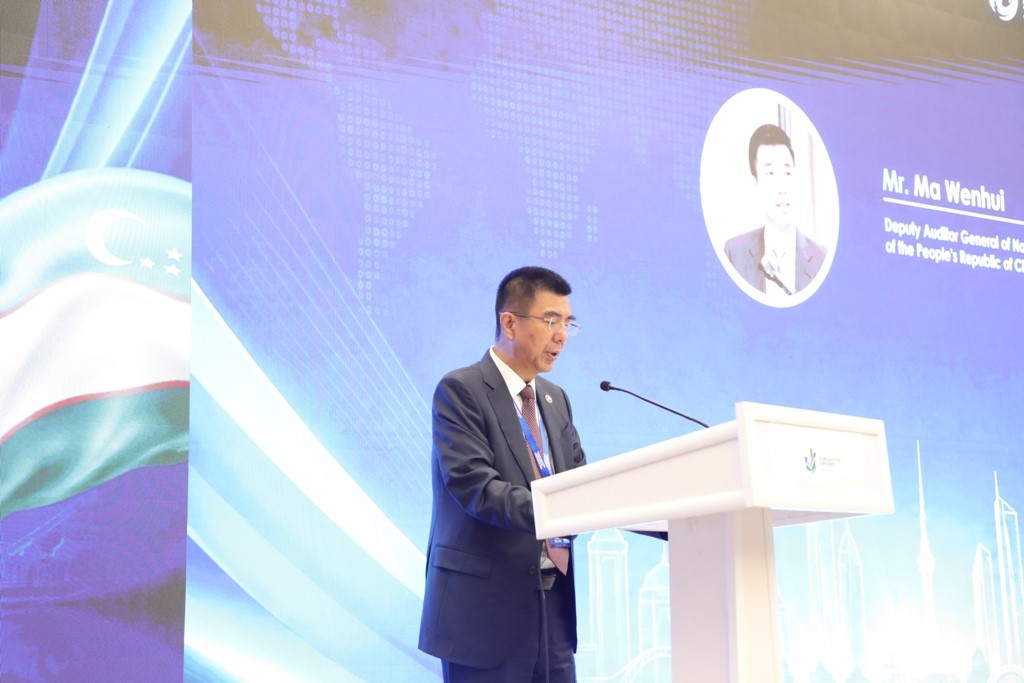
Deputy Auditor General Ma Wenhui first conveyed greetings and best wishes from the Secretary General of ASOSAI and the Auditor General of the National Audit Office of China, Hou Kai, on the successful organization of the conference. He emphasized that digital technologies are a key factor in advancing audit to a new level.
According to him, in recent years the National Audit Office of China has placed special emphasis on strengthening audit capacity based on digital technologies, accelerating the adoption of modern audit methods and tools. In addition, digital transformation has contributed to improving audit efficiency and building a centralized, unified, and comprehensive audit supervision system.
The head of the Chinese delegation highly appreciated the initiative of the Accounts Chamber of the Republic of Uzbekistan in organizing this conference.
During the event, representatives from various countries exchanged views on such topical issues as digital transformation of audit, use of artificial intelligence, Big Data auditing, remote auditing and automated control, as well as cybersecurity and information protection.
According to him, the emergence of generative AI technologies such as ChatGPT and DeepSeek in the past two years has significantly boosted the use of AI across all sectors.
“If Big Data technologies enabled a shift from sample-based audits to full-scope auditing through data aggregation and analysis, then the application of artificial intelligence further deepens this process and will undoubtedly take public audit to a new stage of intellectual development,” he said.
In addition, Chinese experts noted that Supreme Audit Institutions under INTOSAI and ASOSAI, as well as various national audit bodies, have achieved significant progress in improving legal frameworks, building infrastructure, training personnel, and expanding international cooperation, creating a strong foundation for experience sharing.
At the conference, the Chinese delegation presented a detailed overview of its national practices, including:
the use of AI and digital tools in auditing to improve analysis quality, speed, and decision-making processes;
the application of Big Data and AI technologies to enhance audit effectiveness and strengthen its role in public governance.
It should be noted that this international conference was organized within the framework of the tasks set by the President of the Republic of Uzbekistan to improve the state audit and financial control system.
Cooperation between the Accounts Chamber of the Republic of Uzbekistan and the National Audit Office of the People’s Republic of China has been steadily developing in recent years.
In particular, on September 5, 2025, a meeting was held in Beijing between the First Deputy Chairman of the Accounts Chamber, M. Abdullaev, and the Auditor General of China and Secretary General of ASOSAI, Hou Kai, during which a Practical Cooperation Plan (Action Plan) for 2025–2027 was signed.
According to this document:
the parties agreed to introduce innovative solutions and digital technologies in public audit and to ensure regular exchange of experience;
to organize seminars and training sessions on the application of Big Data and artificial intelligence in audit practice and to expand cooperation.
More news
![[object Object]](https://back.ach.gov.uz/media/view/file_3876eec01456bd2a314d9f10.jpg)
25
26.07.2026
![[object Object]](https://back.ach.gov.uz/media/view/file_19ef958e33e7204b96fe2908.jpg)
Report on the COA’s Activities in 2024
2679
29.09.2025
![[object Object]](https://back.ach.gov.uz/media/view/file_78cade577a5ccddd4f46c3e3.jpg)
Meeting with the Chairman of the Chamber of Accounts of Azerbaijan held at the Senate
457
09.03.2026
![[object Object]](https://back.ach.gov.uz/media/view/file_ccd8c89371cd1a1162201006.jpg)
Views of the Representatives of the Czech Republic Delegation about Uzbekistan (Lucie Burianová, Veronika Trasáková)
259
24.05.2026
![[object Object]](https://back.ach.gov.uz/media/view/file_f0a23cbc9f1d373ac97e2fe7.JPG)
A delegation of the Supreme Audit Institution of the Republic of Slovenia visited the Chamber of Accounts
357
25.04.2026